Your doctor has told you to move more. You know you should. You’ve downloaded apps, bought shoes, maybe even signed up for something you never used. And still, you’re not doing it.
 That’s not laziness. It’s not a character flaw. According to decades of behavior change research, you might simply not be ready yet. And “not ready” is a real, recognized stage. One that has its own appropriate response — and it isn’t “just start.”
Why “Just Start” Only Works for Some People
The fitness industry is built on a simple assumption: people want to exercise, they just need the right program, the right motivation, or the right push.
That assumption fits maybe a third of the population. Researchers studying physical activity found that roughly 36% of adults are in what’s called a “pre-action” stage — they’re not exercising regularly and, depending on where they are in that group, they may not even be thinking about it yet. [LINK NEEDED: how fitness apps fail most users]
For everyone else, a workout plan isn’t the missing piece. The missing piece is readiness itself.
The Stages That Come Before the Gym
In the 1980s, psychologists James Prochaska and Carlo DiClemente developed a model that changed how clinicians think about behavior change. Originally built to understand how people quit smoking, it turned out to apply everywhere — including exercise
.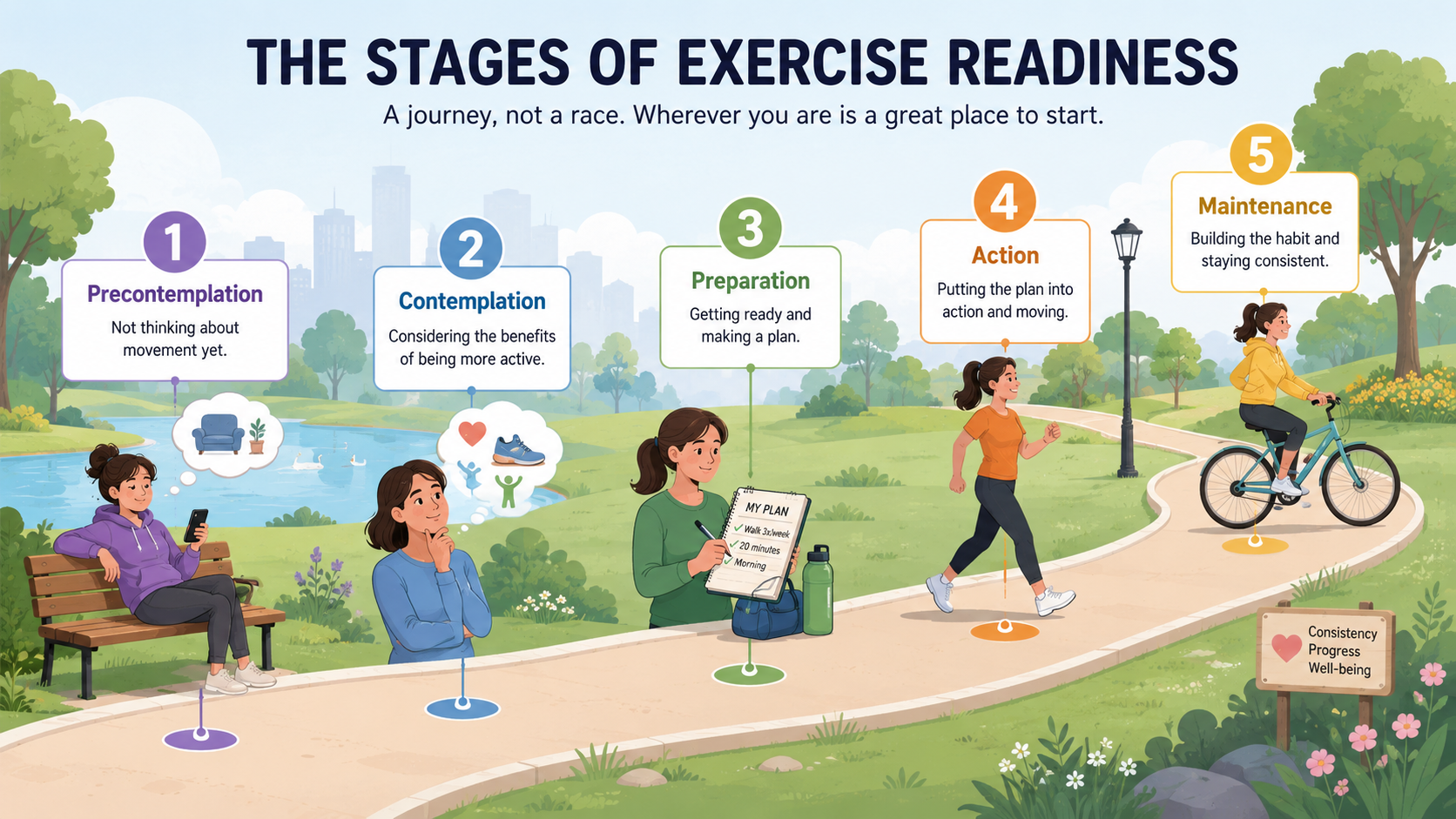
The model describes five stages:
Precontemplation — You’re not thinking about changing. Exercise might feel irrelevant, physically impossible, or just not something for someone like you. This isn’t denial; it’s a legitimate starting place.
Contemplation — You’re aware that moving more might be good for you. You’re weighing it. You haven’t committed to anything, and that’s okay.
Preparation — You’re getting ready to do something. Maybe you’ve taken a few walks, looked things up, or told someone you want to start. You’re building toward action, but you’re not there yet.
Action — You’re actually doing it, though the habit is still new and fragile.
Maintenance — Movement has become part of your life. Consistency is your new challenge, not motivation.
The important thing: each stage has its own needs. What helps someone in Maintenance is completely wrong for someone in Precontemplation. Handing a workout plan to someone who isn’t ready for one doesn’t just fail — it often makes things worse, adding another layer of “I tried and it didn’t work.”
What Actually Helps When You’re Not Ready
If you’re in the earlier stages, the goal isn’t to exercise. The goal is to get curious.
Research on motivational interviewing — a clinical approach designed for people who aren’t ready to change — shows that the most effective support at this stage doesn’t involve persuasion, challenge, or urgency. It involves meeting people where they are and exploring what they actually think and feel about movement. Not what they think they should think.
A few things that genuinely work at the precontemplation and contemplation stages:
Exploring the “why” without pressure. What does moving more mean to you, specifically? Not in general — to you. Playing with grandkids, less back pain, being less tired by 3pm. Concrete and personal matters more than abstract and inspirational.
Separating movement from “working out.” A lot of people aren’t opposed to moving. They’re opposed to the gym, to sports bras, to being watched, to the assumption that they need to get sweaty and sore. Walking counts. Stretching counts. Standing up more often counts. [LINK NEEDED: what counts as exercise for sedentary adults]
Acknowledging that ambivalence is normal. Part of you wants to move more. Part of you really doesn’t want to. Both parts are allowed to exist. The contemplation stage is, by definition, a state of ambivalence — and pushing through it before you’re ready usually snaps you back to the beginning.
Removing the obstacle, not adding the task. If you’re exhausted, in pain, overwhelmed, or dealing with something harder than fitness — that’s the starting point. Movement that fits into a real life is different from movement that requires a different life.
How TOKK Approaches Readiness
Most wellness tools assume you’ve already decided to move. They hand you a plan and a schedule and expect you to follow along.
TOKK works differently because it’s built on the same framework described above. Before recommending any movement, the AI coach works to understand where you actually are — not where the app assumes you should be. If you’re not ready to exercise, that’s a valid answer. The conversation starts there.
For people managing chronic conditions, recovering from surgery, or returning to movement after years away, TOKK’s voice-led coaching is designed to be low-pressure and adaptive. The goal isn’t to push you into action. It’s to help you figure out what “ready” means for you.

You Don’t Have to Be Ready Right Now
If you’ve read this far and you’re still not sure you want to move more, that’s a perfectly reasonable place to be. Contemplation is a stage, not a failure state.
What tends to work — slowly, over time — is staying curious rather than guilty. Noticing what holds you back without judging it. Taking the smallest possible step when it feels genuinely available, not because someone told you to.
Readiness builds. It’s not binary. And the next step, whatever it is, doesn’t have to look like a workout.